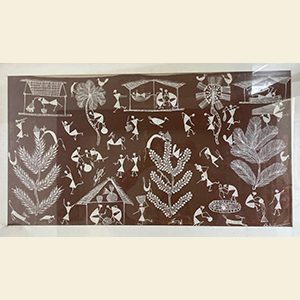
Warli painting comes from the Warli tribe of Maharashtra, with roots dating back to 2,500 BCE. Traditionally painted on hut walls using rice paste, Warli art depicts daily life, farming, dance, and rituals through simple geometric forms—circle, triangle, and square. The central motif often includes Lagnachauk, the marriage deity. The art remained untouched by modern influence until the 1970s, when artists like Jivya Soma Mashe introduced it to the world.
WHAT
MAKES IT
UNIQUE:
White pigment on mud base
Geometric shapes to depict humans, animals, and trees
Ritualistic and ceremonial symbolism
Received a GI tag in 2023
COLOURS
White on red ochre or brown mud background
How much time does it take to make a product, and how many artisans are involved in making this craft? A Warli piece takes 1–3 days, made by 1 artisan using rice-paste linework.
MOTIFS
Daily life: farming, dancing, hunting, weddings
Nature: sun, moon, trees, animals
Rituals and community gatherings
RAW MATERIAL
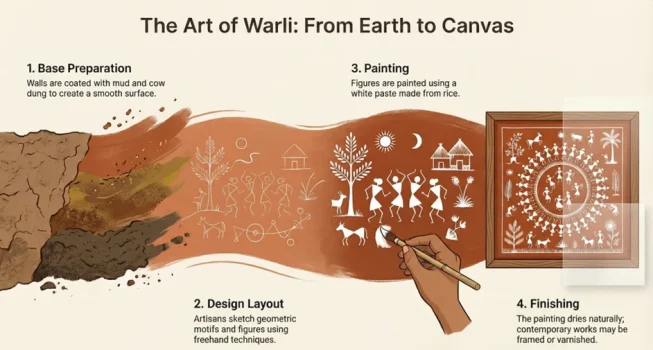
Base: mud walls coated with cow dung (traditional), canvas or paper (modern)
Pigments: white pigment from rice paste and water, sometimes mixed with gum
Brushes: bamboo sticks or fingers
CRAFT MAKING PROCESS
HOW TO IDENTIFY GENUINE WARLI PAINTING
White pigment on earthy or brown background
Geometric shapes forming human, animal, and tree figures