Shantiniketan Leather Craft originated around 1940–1950 in Bolpur, West Bengal, when artisans were trained under the rural craft development initiatives inspired by Rabindranath Tagore at Kala Bhavana (Visva-Bharati University). The craft evolved as a fusion of traditional Bengal artistry with etched and embossed leather techniques. Originally introduced as a means of providing rural employment, Shantiniketan leather soon became recognized for its hand-painted motifs, vibrant colours, and polished finish.
WHAT
MAKES IT
UNIQUE:
Every piece is individually hand-embossed, hand-dyed, and hand-painted, making each product one-of-a-kind.
Strong influence of Bengal folk art, including alpana patterns, floral motifs, tribal art, and scenes inspired by Tagore’s Santiniketan culture.
Shantiniketan Leather Goods from West Bengal received a Geographical Indication (GI) tag
COLOURS
Bright, vibrant shades such as red, yellow, green, orange, blue
Antique two-tone finishes
Lacquered glossy surface
How much time does it take to make a product, and how many artisans are involved in the process? Depending on the size, detailing, and hand-painting complexity, a Shantiniketan leather item takes 3–7 days and typically 2–4 artisans work on a single item
MOTIFS
Floral designs
Alpana patterns
Tribal figures
Birds & animals
Abstract & geometric forms
RAW MATERIAL
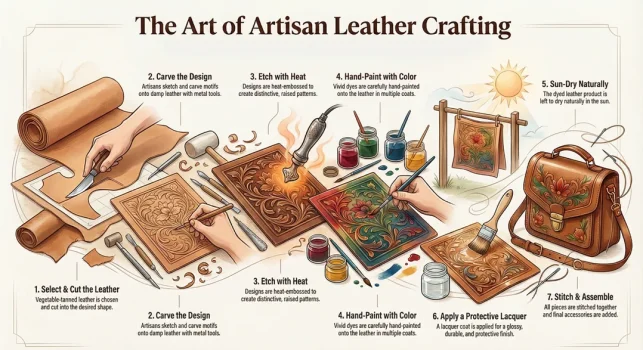
Vegetable-tanned leather
Natural and chemical dyes
Wax, gum, adhesives
Lacquer polish (for glossy finishing)
Metal fittings (buckles, zippers)
Brushes, carving tools, wooden blocks
CRAFT MAKING PROCESS
HOW TO IDENTIFY GENUINE AND AUTHENTIC CRAFT
Real Shantiniketan leather shows slight variations in strokes (proof of handwork).
Authentic items have hand-etched, raised patterns—not printed or machine-stamped.
Genuine pieces have a lacquered, glossy surface that still feels soft to touch.