Craft Name: Marble Inlay (Pachchikari / Parchinkari)

Region: Agra, Jaipur, Makrana

CRAFT
HISTORY

Marble inlay work, globally related to the Italian technique pietra dura, originated in 16th-century Rome and Florence as an elite decorative art. Through gifts and cultural exchange, the technique reached the Mughal Empire, where it evolved into a uniquely Indian expression known as Parchin-kari or Pachchikari. The most iconic example of this craft is the Taj Mahal, where floral motifs, calligraphy, and semi-precious stone inlay transformed Mughal architecture.

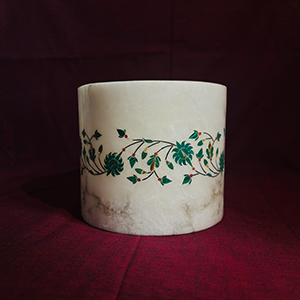
WHAT MAKES IT UNIQUE:

  • Uses semi-precious stones like lapis lazuli, malachite, carnelian, onyx, jade, and mother-of-pearl
  • Designs are typically Mughal-inspired, with Persian floral influences.
  • Surfaces are finished to be perfectly flat, with the marble and stones flush at one level.
  • Pacchikari of Agra is GI Tagged

Received a
GI tag

COLOURS

  • Deep blue (lapis)
  • Green (malachite, jade)
  • Red/orange (carnelian, coral)
  • Black (onyx)
  • Earthy brown (jasper)
  • Iridescent white (mother-of-pearl)

How much time does it take to make a product, and how many artisans are involved in the process?
Depending on the complexity, marble inlay products can take anywhere from 3–7 days to 2–4 weeks and even several months, with typically 4–8 specialized artisans involved throughout the process

MOTIFS

  • Floral: lotus, tulip, poppy, lily
  • Arabesques, vines, cypress trees
  • Birds, pomegranates, grapes

RAW MATERIAL

  • Makrana white marble
  • Inlay stones
  • Adhesives & fillers
  • Emery powder
  • Sandpaper

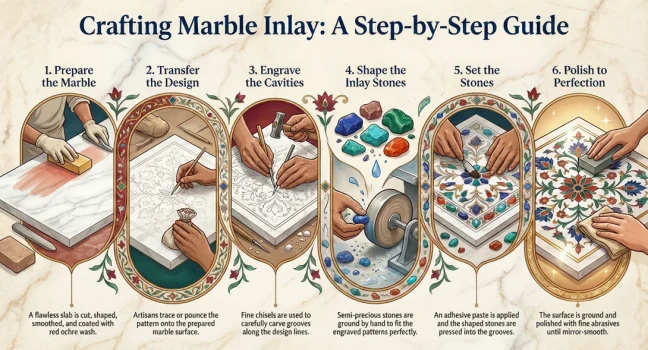
CRAFT MAKING PROCESS

Marble Inlay

HOW TO IDENTIFY GENUINE AND AUTHENTIC CRAFT:

  • Material & Weight: Real marble is heavy, cool to touch
  • Visible Embedded Stones: From the side, you should see thin stone pieces inserted into cavities.