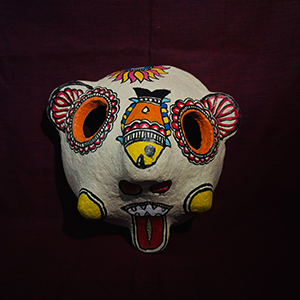
Madhubani (or Mithila) art has ancient roots in ritual wall paintings created during weddings, festivals, and harvest rituals. Paper mâché evolved later as an eco-friendly extension of Madhubani painting, allowing artists to create 3-D objects that retained traditional surface aesthetics. Masks in Madhubani are particularly significant, often depicting gods, goddesses, folk characters, animals, and ritual symbols used during festivals, storytelling, and cultural theatre.
WHAT
MAKES IT
UNIQUE:
Combines sculptural paper mâché with traditional Madhubani linework and motifs.
Strong cultural symbolism rooted in Mithila folklore, deities, and rituals.
Uses recycled materials, making the craft sustainable and low-cost.
Masks are lightweight, durable, and visually expressive.
Received a GI tag in 2023
COLOURS
Traditional colours: red, black, yellow, green, blue
Natural pigments traditionally; now mostly acrylic for durability
How much time does it take to make a product, and how many artisans are involved in the process? A Madhubani papier-mache mask takes 3–8 days to make and involves 1–2 artisans in the process
MOTIFS
Eyes, facial expressions, deities
Fish, Peacocks, elephants, turtles
Lotus, creepers, geometric borders
Fine double-line outlines with crosshatching
RAW MATERIAL
Waste paper/newspapers
Maida paste or natural gum
Clay or chalk powder
Cotton cloth strips
Natural or acrylic paints
Varnish for final finish
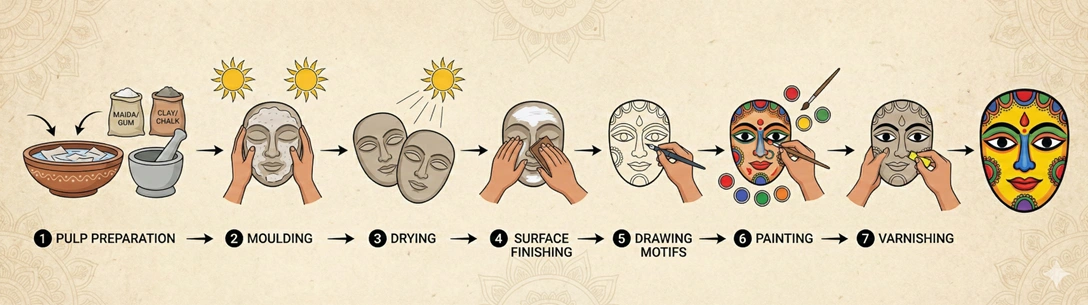
CRAFT MAKING PROCESS
HOW TO IDENTIFY GENUINE AND AUTHENTIC CRAFT
Hand-painted Details: Authentic masks have visible brush strokes, fine lines, and uneven organic textures, not printed designs.
Traditional Motifs: Look for Madhubani elements like double lines, crosshatching, and symbolic motifs.
Natural Imperfections: Minor irregularities indicate handcrafted work, not factory moulding.
Cultural Accuracy: Masks often follow traditional proportions and deity representations unique to Mithila art.