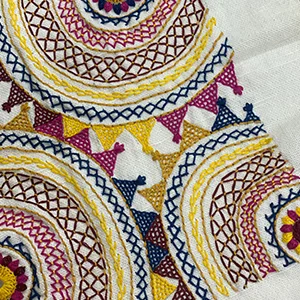
Lambadi embroidery originates from the nomadic Banjara / Lambani tribe. As travelling traders and transporters, Lambanis developed an embroidered language reflecting their cultural journeys, using vibrant threads, mirrors, coins, and shells. Historically, women embroidered their own garments, veils, and accessories with meaningful symbols representing fertility, protection, nature, and tribal identity. During the 19th century, Lambani communities settled in southern India, where their embroidery evolved into a distinctive folk tradition known for bold colours and dense patterns. The craft gained visibility through rural craft initiatives in the 20th century, eventually entering urban markets through garments, home décor, and accessories.
WHAT
MAKES IT
UNIQUE:
Bold use of mirrors, coins, shells, beads.
Dense, geometric embroidery with bright contrasting colours.
Uses stitches like knot, herringbone, and cross stitch.
Received a GI tag in 2023
COLOURS
Highly saturated colours: red, yellow, blue, orange, white.
Bright contrast defines authenticity; darker bases with bold accents are traditional.
MOTIFS
Triangles, squares, and grids
Sun, star, bird forms
Tribal symbols
Mirror motifs and borders
RAW MATERIAL
Fabrics: coarse cotton, handloom khadi, canvas
Threads: bright red, yellow, white, blue cotton threads
Mirrors (shisha), coins, shells
Fabric patches, beads, cowries
Needles, frames
CRAFT MAKING PROCESS
HOW TO IDENTIFY GENUINE LAMBADI WORK
Heavy texture with multiple layers (stitches + mirrors).
Slight irregularities due to hand-applied patches and hand-cut mirrors.
Vibrant colours without synthetic shine.
Traditional pieces include coins, shells, and dense borders.