Blue pottery originated in Turkey and was brought to India during the 14th-century Turkic invasions. The craft was further developed under Mughal patronage and later flourished in Jaipur during the 17th to 19th centuries. Maharaja Sawai Ram Singh II played a vital role in promoting this craft by inviting artisans to Jaipur and helping establish it as a local specialty.
The craft’s roots lie in Turko-Persian traditions, combining Persian designs and Chinese glazing techniques with the local Indian context.
WHAT
MAKES IT
UNIQUE:
Blue pottery is distinct for its use of cobalt oxide-based blue dye, translucent body made from quartz, and glazing without the use of clay.
No use of clay in making the pottery
Its vibrant blue color combined with floral, geometric, bird, and animal motifs makes it stand out. The pottery is low-fired and glazed, creating a semi-transparent, smooth finish.
Received a GI tag in 2023
COLOURS
Predominantly cobalt blue and white, with occasional additions of turquoise, black, green, and yellow hues.
How much time does it take to make a product, and how many artisans are involved in making this craft? A Blue Pottery product typically takes 5–12 days to make and involves 2–4 artisans in the process
MOTIFS
Common motifs include floral patterns, geometric designs, birds, and animals inspired by Persian and Mughal art styles.
RAW MATERIAL
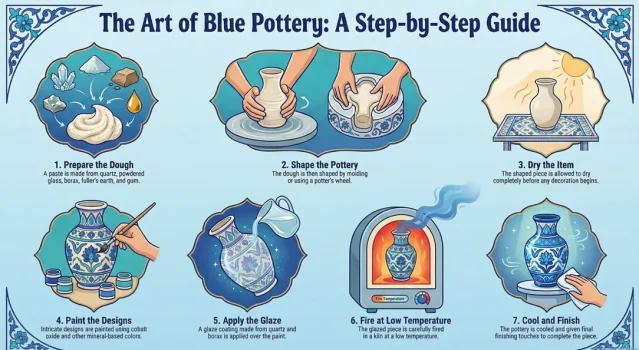
Quartz powder, powdered glass, fuller’s earth, borax, gum, and water.
CRAFT MAKING PROCESS
HOW TO IDENTIFY GENUINE AND AUTHENTIC CRAFT
Look for the distinctive translucent blue glaze and smooth finish.
Confirm the absence of clay in the pottery body.
Authentic pieces exhibit hand-painted cobalt blue motifs with uneven brush strokes indicating manual work.
Verify the origin by checking for Jaipur or Rajasthan craft certification or from known authentic sellers.