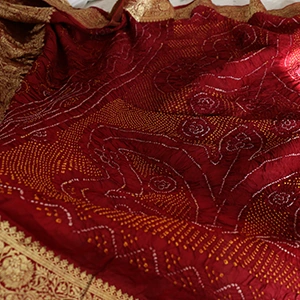
Bandhej or Bandhani is one of India’s oldest tie-and-dye traditions, dating back to 6th-century Gujarat and Rajasthan. Ancient mural paintings and Jain scriptures depict women wearing dotted tie-dye patterns. The craft flourished under Rajput, Kutch, and Sindhi kingdoms, where colourful odhanis and turbans symbolised prosperity and celebration. Bandhej involves tightly tying fabric with thousands of tiny knots before dyeing it in vibrant colours. Communities such as the Khatri artisans preserved the craft across generations. During the Mughal period, Bandhani gained popularity for its intricate patterns and soft drape.
WHAT
MAKES IT
UNIQUE:
Thousands of tiny hand-tied knots form detailed patterns.
Uses vibrant dyes with cultural meaning.
Received a GI tag in 2023
COLOURS
Bright reds, maroons, indigo, yellow, black; combinations often symbolic
How much time does it take to make a product, and how many artisans are involved in making this craft? Bandhej takes 15-30 days, involving 1–3 artisans in the process
MOTIFS
Small dots (bandhani), circular phulkari-like rosettes, stripes, and waves.
RAW MATERIAL
Fabrics: cotton, georgette, chiffon, silk
Dyes: natural (historically) and synthetic modern dyes
Threads for tying (wrapping) and bamboo/wooden poles for stretching
CRAFT MAKING PROCESS
HOW TO IDENTIFY GENUINE BANDHEJ
Tiny, hand-tied dots with slight irregularities.
Fine dot clusters & gradation from repeated tie-dye.