Craft Name: Ajrak

Region: Kutch (Gujarat), Barmer & Jaisalmer (Rajasthan)

CRAFT
HISTORY

Ajrak is an ancient block-printing tradition practiced for over 3,000 years in Sindh and later in Kutch, Gujarat. The craft evolved along the Indus Valley civilisation, where artisans mastered natural dyes, geometric patterns, and symmetrical layouts. Ajrak became deeply connected with pastoral communities, especially the Maldhari tribes, who wore Ajrak as a symbol of honour, identity, and protection. The craft flourished under Mughal and regional patronage, incorporating complex printing sequences using hand-carved blocks.

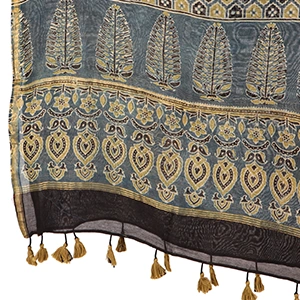
WHAT MAKES IT UNIQUE:

  • Involves 14–20 steps of resist-dyeing and block printing.
  • Uses natural dyes like indigo, madder, and jaggery.
  • Ajrak – Kutch Ajrakh has received GI certification

Received a
GI tag

COLOURS

  • Deep indigo, madder red, black/brown neutrals, and muted whites.

How much time does it take to make a product, and how many artisans are involved in making this craft?
An Ajrak piece takes 10–21 days, made by 2–4 artisans

MOTIFS

  • Geometric repeats, stars, floral rosettes, medallions, and trellis patterns.

RAW MATERIAL

  • Fabrics: cotton, mul/mul (handloom), silk
  • Wooden printing blocks, carved stamps
  • Natural dyes: indigo, madder, alum mordant
  • Resist pastes (gum/clay), washing tubs

CRAFT MAKING PROCESS

The-Art-of-Zardozi

HOW TO IDENTIFY GENUINE AJRAK

  • Crisp motifs visible on both sides.
  • Texture and scent typical of natural indigo/madder.
  • Designs appear sculpted rather than flat.
  • Gold/silver tones have natural sheen, not plastic shine.