Region: Tamil Nadu, Karnataka, Kerala, Assam, Andhra Pradesh
CRAFT
HISTORY
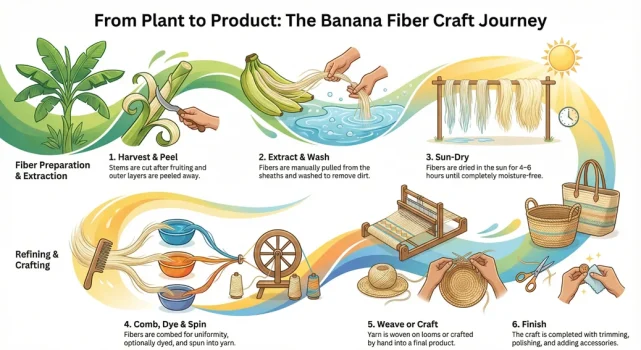
Banana Fibre Craft has its origins in South India, where banana plants were cultivated extensively for food, rituals, and household use. Traditionally, after harvesting the fruit, the banana pseudostem was considered agricultural waste. Rural communities began extracting fibres from the inner bark to make ropes, mats, cords, and threads. Over generations, artisans developed advanced techniques to convert banana fibre into a soft, glossy, and durable natural textile.
WHAT
MAKES IT
UNIQUE:
Eco-friendly & sustainable: Uses agricultural waste from banana cultivation.
Lightweight yet strong fibre: Comparable to jute or hemp in durability.
Distinct natural sheen: Golden or beige silky appearance.
Biodegradable and chemical-free: No toxic processing involved.
Versatile use: Can be woven, braided, twisted, crocheted, or integrated with cotton, jute, or silk.
Received a GI tag in 2023
COLOURS
Natural golden beige
Dyed tones: brown, maroon, green, mustard, black
Two-tone patterns when blended with cotton or jute
How much time does it take to make a product, and how many artisans are involved in the process? Depending on product type and detailing it may take 5–10 days and typically 2-6 artisans work on a single piece.