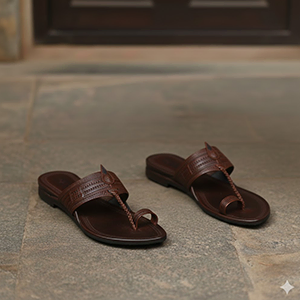
Kolhapuri chappals date back to the 13th century, during the rule of the Maratha kings and later the Chhatrapati Shivaji Maharaj period. These handcrafted leather sandals were traditionally made for durability, comfort, and long walking journeys.
The tanning and crafting skills flourished in the district of Kolhapur, where families passed down techniques through generations. The craft gained national recognition in the 20th century for its high-quality vegetable-tanned leather, intricate braiding, and distinctive hand-stitching.
WHAT
MAKES IT
UNIQUE:
Made from 100% hand-processed vegetable-tanned leather, using natural ingredients like babul bark.
Kolhapuri chappal is GI Tagged, preserving regional authenticity.
Artisans use no chemicals; tanning is done through traditional eco-friendly methods.
Received a GI tag in 2023
TYPES OF KOLHAPURI CHAPPALS
Kapshi – very soft, iconic pointed front
Paytaan – fine braiding, classic look
Kachkadi – lightweight variant
Lingdi – minimalist single-toe-ring style
Bandhawa – tied designs with complex weaving
How much time does it take to make a product, and how many artisans are involved in the process? A Kolhapuri chappal usually requires 1–3 days to complete and involves 2–4 artisans working on one pair
MOTIFS & DESIGN CHARACTERISTICS
Hand-braided straps
Toe-ring (bitta) unique to Kolhapuri style
Punched geometric patterns on the vamp
Floral or dotted motifs
Thick, durable multi-layered leather sole
RAW MATERIAL
Buffalo leather
Goat leather
Vegetable tanning agents
Natural dyes
Cotton threads
Copper or brass nails
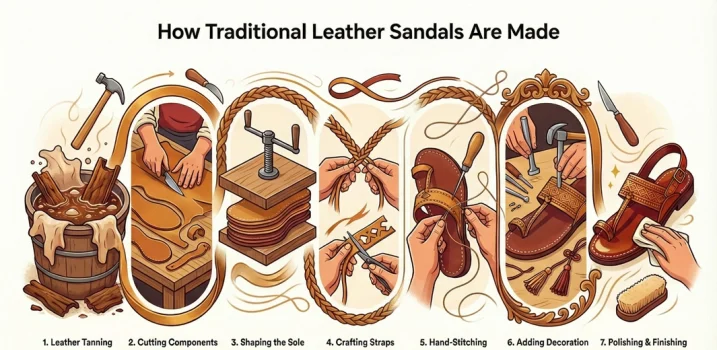
CRAFT MAKING PROCESS
HOW TO IDENTIFY GENUINE AND AUTHENTIC CRAFT
Smell Test: Genuine Kolhapuris smell like natural leather and bark tanning, never like chemical polish.
Stitching: Hand-stitches are slightly irregular and thick; machine stitching indicates imitation.
Weight: True Kolhapuris are lightweight yet sturdy.
Flexibility: Vegetable-tanned leather becomes softer with use and moulds to the wearer’s foot.