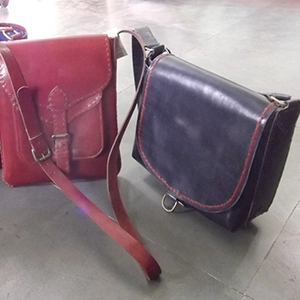
Jawaja Leather Craft has been practiced for over 300 years by the Regar Samaj, a community skilled in tanning and making leather products such as saddles, mojaris, and harnesses. Located in the drought-prone region around Beawar and Jawaja, leatherwork emerged as their core livelihood.
The craft saw a major revival in 1975 through the Jawaja Project (Rural University Initiative) led by Prof. Ravi Matthai (IIM Ahmedabad) and Ashoke Chatterjee (NID), giving artisans market access and reinventing the craft for contemporary use.
WHAT
MAKES IT
UNIQUE:
Products are stitched using leather laces instead of thread, creating a unique diamond-shaped stitch.
Entirely handcrafted from start to finish, no machines used.
Received a GI tag in 2023
COLOURS
Terracotta red base
Geru reds, greens, yellows, whites, and blacks in flat, bold colour blocks
How much time does it take to make a product, and how many artisans are involved in the process? Depending on size and intricacy, Molela plaques typically take 3–7 days involving 1–3 artisans.
TEXTURE
Natural, uneven leather grain
Visible hand-stitched diamond-pattern lacing
Rich tones from vegetable tanning
How much time does it take to make a product, and how many artisans are involved in the process? While a medium-sized bag can be hand-stitched in one day by 2 people but the leather preparation takes nearly one month.
RAW MATERIAL
Buffalo & cow leather
Leather strips for stitching
Cotton yarn
Natural oils, waxes, and polishes for finishing
CRAFT MAKING PROCESS
HOW TO IDENTIFY GENUINE AND AUTHENTIC CRAFT:
Signature diamond-shaped stitch made from leather strips, not synthetic thread.
Visible grain, subtle wrinkles, and organic texture indicate authenticity.