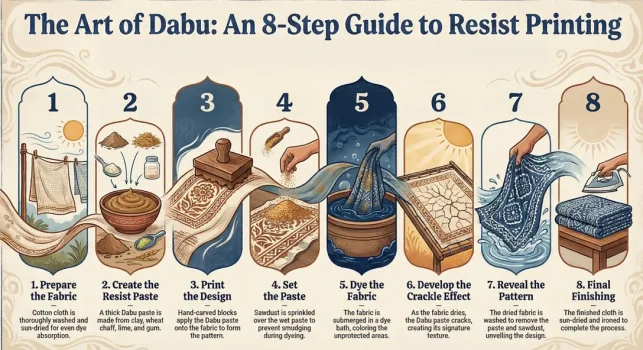
Dabu printing is an ancient mud-resist technique rooted in the desert regions of Rajasthan, especially in villages around Bagru and Akola. Its origins go back several centuries, evolving within traditional communities known as Khatris. Historically, Dabu was used to create deep indigo-dyed textiles worn by rural communities and pastoral groups. The process involves applying a handmade resist paste of black clay, lime, and natural gum to block-printed designs, followed by dyeing in natural indigo. Mughal and Rajput influences enriched the motifs, which often included florals, trellises, and geometric patterns.
WHAT
MAKES IT
UNIQUE:
Use of a fermented mud paste (dabu) that produces rich textures and unique resist effects combined with natural indigo and vegetable dyes.
Received a GI tag in 2023
COLOURS
Indigo with earthy madder and brown tones; soft mottled textures.
How much time does it take to make a product, and how many artisans are involved in making this craft? A Dabu piece takes 5–15 days, involving 2–4 artisans in the process
MOTIFS
Florals, small repeats, and geometric borders.
RAW MATERIAL
Mud-resist technique using handmade Dabu paste
Dabu printing is internationally recognised for its eco-friendly production, earthy aesthetics, and handcrafted authenticity.
CRAFT MAKING PROCESS
HOW TO IDENTIFY GENUINE DABU PRINT
Look for slight irregularities in resist and prints.
Natural indigo smell and subtle colour variations.
Motifs appear slightly textured, not flat like screen prints.