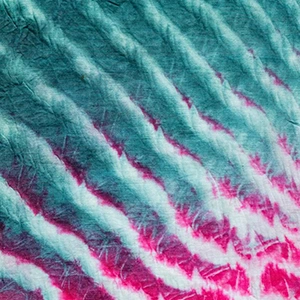
Shibori is a centuries-old Japanese resist-dyeing technique that travelled to India through textile exchange and contemporary craft revival movements. Indian artisans adopted Shibori in Rajasthan, and Gujarat, integrating it with local dyeing practices. Shibori gained popularity in India in the late 20th century due to designers and craft institutions promoting natural indigo, madder, and eco-dyes.
WHAT
MAKES IT
UNIQUE:
Uses binding, stitching, clamping, folding as resist methods.
Creates unpredictable, organic patterns.
Received a GI tag in 2023
COLOURS
Strong indigos, monochromes, and multi-dye effects.
How much time does it take to make a product, and how many artisans are involved in making this craft? A Shibori piece takes 2–7 days, made by 1–2 artisans in the process
MOTIFS
Organic circles, wave patterns, linear folds, pleated textures.
RAW MATERIAL
Fabrics: silk, cotton, linen
Dyes: indigo, synthetic dyes
Stitching tools, clamps, bindings, boards for compression
CRAFT MAKING PROCESS
HOW TO IDENTIFY GENUINE SHIBORI
Visible evidence of folding/pleating and stitch-resist marks.
Depth of indigo penetration and soft gradations from hand-dye.