Region: Kerala, Tamil Nadu & Karnataka, Goa, West Bengal
CRAFT
HISTORY
Coconut-shell use began as an economy-of-waste: shells left after copra extraction were repurposed into household utensils and tools. Over time skilled cutters and carvers in coconut-rich coastal communities developed controlled carving, turning and brass-inlay/embroidery techniques to make decorative and functional objects. In places like Kerala the craft professionalized into village/clusters and specialized products; in West Bengal artisans shifted from scarce conch shell carving to coconut shell carving in the late 20th century.
WHAT
MAKES IT
UNIQUE:
Brass-embroidery in Kerala: a regionally distinct technique where artisans combine carved shell forms with fine brass
The Kerala brass-broidered coconut shell craft has a Geographical Indication entry
COLOURS
Traditional palettes include rich jewel tones, maroon, emerald, navy, royal blue, paired with gold or silver zari.
How much time does it take to make a product, and how many artisans are involved in making this craft? A Zardozi piece takes 3–20 days, involving 2–5 skilled karigars
MOTIFS
How much time does it take to make a product, and how many artisans are involved in making these crafts? A coconut craft item takes 1–5 days, usually made by 1–2 artisans
RAW MATERIAL
Coconut shell
Coir or jute cord
Adhesives
Pigments/paints
Polishing oils
Tools
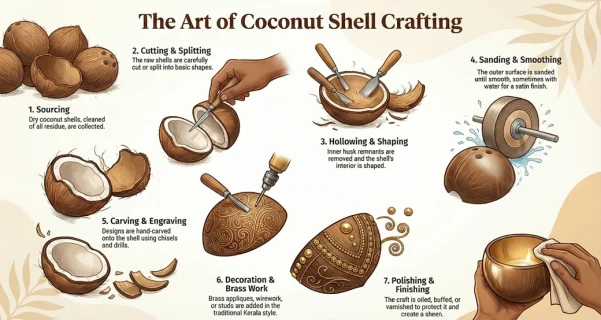
CRAFT MAKING PROCESS
HOW TO IDENTIFY GENUINE AND AUTHENTIC CRAFT:
Real shell is solid and surprisingly dense; it has a slightly fibrous inner texture and warm, organic feel
Well-polished shell shows natural grain and subtle variance; hand finish leaves faint tool marks or brush strokes